The Loom School
Make something that matters.

— JK-Grade 8 • Grade 9 Launching Fall 2027
Make something that matters.
The Loom is a project-based independent school serving families in the Ottawa region. Built for learners who want more ownership, greater purpose, and a community where they matter.

— ABOUT THE LOOM
Welcome to Ottawa's Studio School
The Loom School is a not-for-profit school, built on three years of experience as ARC Studio School. We currently serve JK–Grade 8, with Grade 9 launching in the fall of 2027.
The Loom is designed to support children’s innate creativity and curiosity, challenging them through meaningful, collaborative projects. At The Loom, we envision a future where children are trusted, supported, and ultimately, grow into young adults with the confidence, skills, and experience to weave a life that’s genuinely their own.
The Loom is led by Megan Lelli, a psychiatrist who spent years working in early childhood mental health, and Misha Lelli, an entrepreneur and UX designer — co-founders who built the school around one question: what would it look like if school were designed, from the ground up, around what children actually need?
Founded by megan & Misha Lelli
Megan Lelli spent years as a psychiatrist working with young children who had already lost their curiosity and love of learning — and watched the same thing start to happen with her own daughter. Unable to find the kind of school these children needed, she built it, together with her husband Misha, an entrepreneur and UX designer who has spent his career asking one question: who is this for, and does it work for them? The Loom opened with a small founding cohort in Ottawa and has grown deliberately since, shaped by the families who've joined it.
— WHY THE LOOM
A loom is a frame — the structure that holds many threads together and weaves them into something no single thread could make alone. That's what we believe a school should do. Every child arrives with their own questions, strengths, and story. Our job is to build a community where those differences make the whole richer.
— WHY THE LOOM
Every child is a thread.
The school is the frame.
A loom is a frame — the structure that holds many threads together and weaves them into something no single thread could make alone. That's what we believe a school should do.
Every child arrives with their own questions, strengths, and story. Our job is to build a community where those differences make the whole richer.
We don't smooth those differences out.
We build a frame strong enough to hold them all together.
— What We Believe
Curiosity begins with trust.
Most schools are designed to manage children — sort them, measure them, move them through. We believe children want to be trusted, challenged, and seen for who they are. When that happens, school ignites in children what it's supposed to: curiosity, creativity, and the drive to push through something hard and make something that matters.
That's what we set out to build. Learners take on real, open-ended challenges — the kind without a right answer at the back of the book. The work is messy, collaborative, and purposeful.
_JPG.jpg)
— Our Three Pillars
Agency, purpose, community.
Agency
Every learner has genuine power over their own learning.
Agency is both a process and an outcome, built deliberately over time. With guidance and the chance to try, fail, and try again, learners develop the mindsets and skills to direct their own learning — and eventually, their own lives.
Purpose
What we do connects to something larger than ourselves.
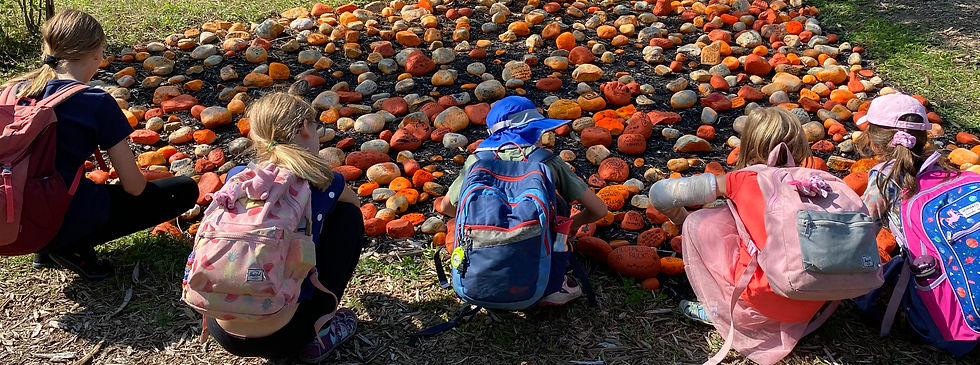
Purpose is the answer to the question every learner eventually asks: why are we learning this? When the work is meaningful — to them, to someone else — they engage more fully, think more deeply, and push the work further than they thought they could. Ottawa is where that meaning comes from: its history, its communities, and its unsolved problems.
Community
We learn better, and become better, together.
The goal isn't independence — it's interdependence. Learning to collaborate and build something together is core to the work, not an extra. The diversity of our community, in background and perspective, makes the work — and the school — stronger.
— Our Three Pillars
Agency, purpose, community.
Agency
Every learner has genuine power over their own learning.
Agency is both a process and an outcome, built deliberately over time. With guidance and the chance to try, fail, and try again, learners develop the mindsets and skills to direct their own learning — and eventually, their own lives.
Purpose
What we do connects to something larger than ourselves.
Purpose is the answer to the question every learner eventually asks: why are we learning this? When the work is meaningful — to them, to someone else — they engage more fully, think more deeply, and push the work further than they thought they could. Ottawa is where that meaning comes from: its history, its communities, and its unsolved problems.
Community
We learn better, and become better, together.
The goal isn't independence — it's interdependence. Learning to collaborate and build something together is core to the work, not an extra. The diversity of our community, in background and perspective, makes the work — and the school — stronger.

— What Makes us different
Three structural choices.
Guides, not teachers
Questions, not answers.
A guide's job isn't to deliver answers — it's to ask the questions that help a learner think through a problem, reflect on a choice, and find their own way forward.
Mixed-age studios
Different ages, working together.
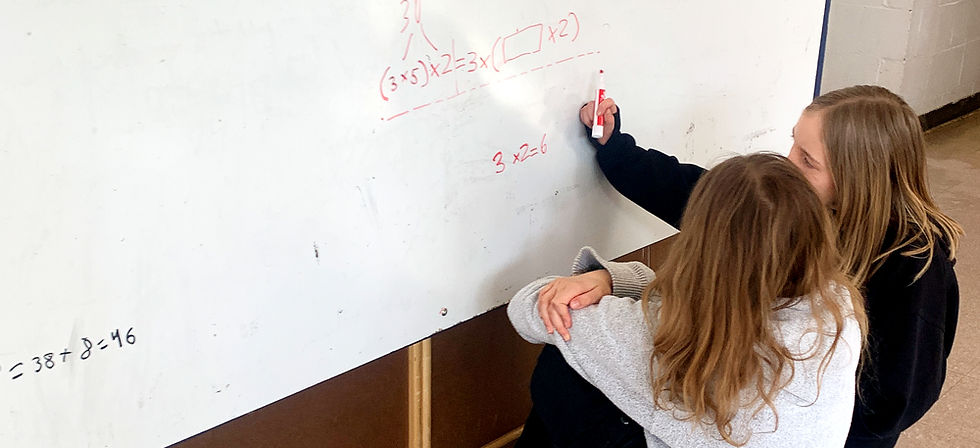
Children of different ages work, investigate, and make together. Every project demands different skills and benefits from the individual strengths of each learner.
No tests, no grades
A portfolio, not a report card.
Progress is tracked through guide coaching, self-reflection, peer feedback, and a portfolio every learner builds beginning in Elementary.
— Builds: the heart of how we learn
Real questions. Real work. Real audiences.
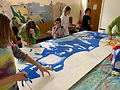
Builds investigate questions rooted in Ottawa — its history, its communities, its challenges, its stories. The outcome might be a design, a documentary, a piece of investigative writing, a stage production, a policy proposal, an art installation. No lecture, no textbook. The school year is organized into three terms, each made up of two five-to-six-week sessions.
Every Build begins with a brief — an open-ended challenge — and moves through a genuine design process. Along the way, learners make real decisions, revise their thinking, and learn to explain their choices.
What changes as learners grow is the depth, independence, and reach of their work. In Elementary, guides scaffold every step and learners present to families. In Middle School, community experts bring outside perspective into the investigation. In High School, the work goes out into the world — submitted to organizations, publications, or civic bodies.
Every session ends with an exhibition. Learners share what they have made and walk through the decisions that got them there — the choices, the dead ends, the revisions.

ONE SCHOOL. FOUR STAGES.
The same convictions, expressed differently at every age.
What changes across fourteen years is how much of the learning the child is ready to carry. A four-year-old needs a guide close by. A seventeen-year-old mostly needs to be trusted. Each stage is built to hand something forward to the next.
— A Look at each stage
From Early Years to High School
We place each learner where they'll be challenged and supported, not by age or grade alone.
_JPG.jpg)
— From our families
What it feels like from the inside.
"Our child is genuinely seen and known, and that creates a school experience that feels profoundly different."
— Clare, Studio 1 parent
"We did a three-day trial and he was hooked; he didn't even want to wait until the next session to start."
— Kate, Studio 2 parent
ONE SCHOOL. FOUR STAGES.
The same convictions, expressed differently at every age.
What changes across fourteen years is how much of the learning the child is ready to carry. A four-year-old needs a guide close by. A seventeen-year-old mostly needs to be trusted. Each stage is built to hand something forward to the next.
— Joining the loom
Four steps to enrollment.
We place each learner where they'll be challenged and supported, not by age or grade alone.
1. Start a conversation
01
Tell us about your child and what brings you here.
2. Visit us
02
Spend time with our Head of School and co-founder, Megan Lelli, get a feel for the community, and ask us anything. We encourage you to bring your child along.
3. Studio trial
03
Your child spends a day with us. (Not available over the summer.)
4. Welcome to The Loom
04
If it's a good fit, we're glad to have you.
Ottawa is located on the unceded territory of the Anishinabe Algonquin people. The Loom School acknowledges this territory and the ongoing presence of the Algonquin nation. We are committed to weaving this awareness into the learning that happens here — not as a declaration, but as a practice.
Land Acknowledgement
.jpeg)